Nikkei has reported that the global new car sales landscape will change in 2025, with Chinese automakers surpassing Japanese automakers in total sales for the first time, taking the top spot. This marks the first time since 2000 that Japanese automakers have lost their leading position.
Statistics show that Chinese automakers saw significant overall sales growth, reaching nearly 27 million units, a year-on-year increase of approximately 10%; Japanese automakers, on the other hand, saw a slight decrease to around 25 million units. Among the top 20 automakers, Chinese companies occupied 6 spots, exceeding the number of Japanese companies with 5.
Among them, BYD and Geely’s sales have surpassed Nissan and Honda, respectively. BYD’s annual sales reached 4.6 million units, a year-on-year increase of 8%, surpassing not only Ford but also Tesla in the pure electric vehicle sector, becoming the world’s number one. Its overseas sales exceeded 1 million units for the first time, accounting for approximately 20% of its total sales.
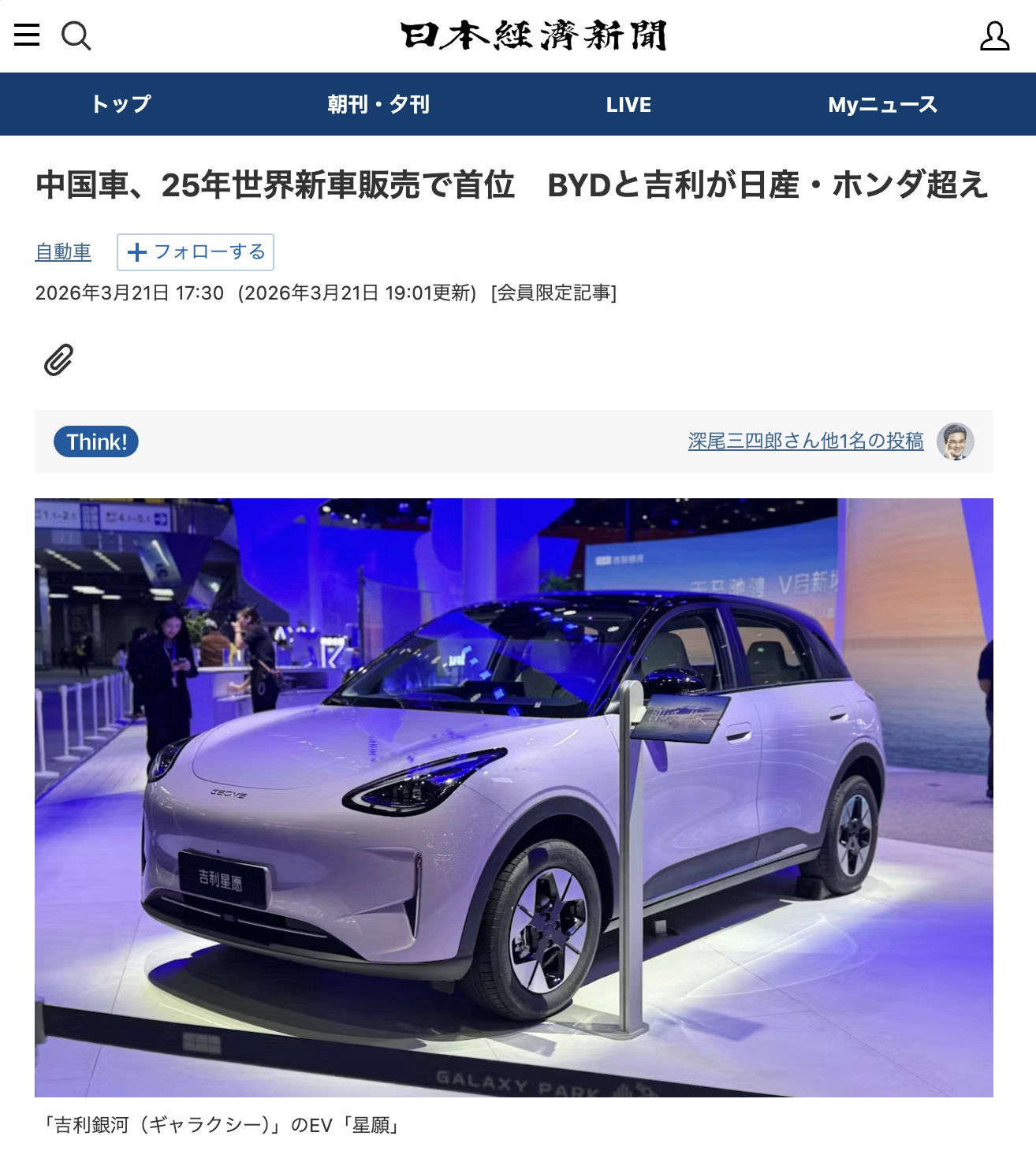
Geely’s sales increased by 23% year-on-year to 4.11 million units, rising to 8th place. The “Star Wish” small pure electric vehicle, launched in 2025, performed strongly in the Chinese market, while also driving the company to accelerate its expansion into overseas markets such as Central and South America.
In contrast, Japanese automakers as a whole are under pressure. Except for Toyota and Suzuki, all other major manufacturers saw a decline in sales. Toyota remains the world’s number one automaker with 11.32 million units sold for the sixth consecutive year, while Volkswagen ranks second with 8.98 million units sold.
Honda’s sales fell 8% to 3.52 million units, ranking 9th, the largest decline among the top 20, with sales in the Chinese market plummeting by 24%. The company expects a net loss of up to 690 billion yen for the fiscal year ending March 2026 and has initiated structural reforms.
Nissan’s sales fell 4% to 3.2 million units, dropping to 11th place and failing to make the top ten for the first time since 2004, overtaken by Suzuki. The domestic market in Japan performed poorly, declining by 15% year-on-year.
According to reports from IT Home, Chinese automakers are accelerating their global expansion. Geely plans to increase its global sales to over 6.5 million units by 2030, with overseas sales accounting for more than one-third; Chery has set a sales target of 3.2 million units for 2026; and Leapmotor plans to increase its sales to 1 million units.
Meanwhile, Chinese automakers are shifting from solely exporting to local production to enhance their cost advantages. BYD and Geely have reportedly expressed interest in acquiring Nissan’s factory in Mexico.
The report points out that if Japanese automakers cannot improve their cost competitiveness, the gap between them and Chinese automakers may widen further.