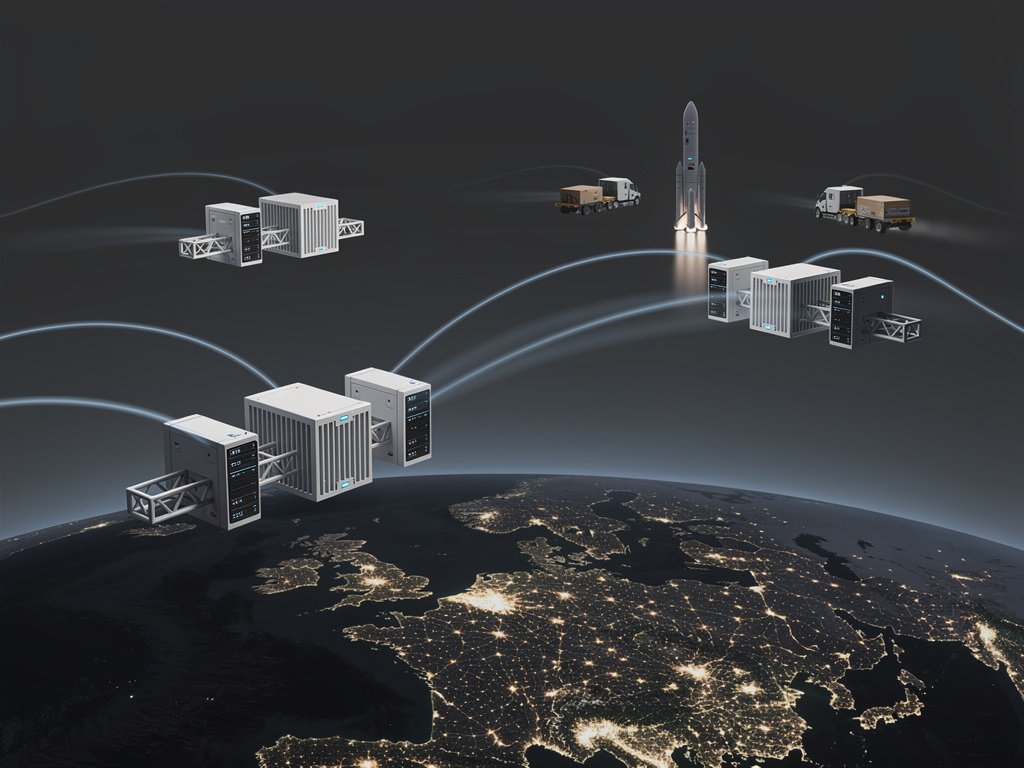
The artificial intelligence industry is facing an energy crisis that could redefine how and where data is processed. Now, two of the sector’s most influential figures — Sam Altman and Elon Musk — are openly discussing a solution that shifts computing beyond Earth’s surface.
According to Business Insider, Altman recently suggested that space-based data centres could become viable within the next few years, potentially by 2026 or 2027. Musk has echoed similar views, pointing to the falling cost of orbital launches as a critical turning point.
The urgency stems from AI’s extraordinary electricity demand. In 2024, Goldman Sachs estimated that United States data centre power consumption could more than double by 2030, largely driven by AI workloads. Meanwhile, the International Energy Agency projected global data centre electricity use could reach 1,000 terawatt-hours annually by 2026 — roughly equivalent to Japan’s total national consumption.
These projections are already straining infrastructure. In Northern Virginia, the world’s largest data centre hub, Dominion Energy has warned of potential shortages. Similar pressure is building in Texas, Ireland and the Netherlands, where grid expansion is struggling to keep pace with AI growth.
Major technology firms have responded with long-term renewable contracts, nuclear investments and geothermal exploration. Yet these projects require years to develop, while AI training clusters are expanding at unprecedented speed.
Altman argues that orbit offers a fundamental advantage: uninterrupted solar exposure. Without atmospheric interference, solar panels in space can generate between five and ten times more energy per square metre than those on Earth. For AI companies seeking abundant, carbon-free power, the appeal is clear.
The economic case hinges on launch costs. SpaceX’s next-generation rocket, Starship, is designed to reduce the price of delivering cargo to orbit to roughly $10 per kilogram — a dramatic drop from traditional rockets that cost thousands per kilogram. If realised, this shift could significantly alter the economics of placing computing hardware in space.
Musk’s position is distinctive. As founder of SpaceX and head of xAI, he both controls launch infrastructure and operates large-scale AI systems. His company’s Colossus supercomputer in Memphis is reportedly among the largest AI training facilities globally, already placing pressure on local power grids.
SpaceX’s experience with Starlink — which operates more than 6,000 satellites in low Earth orbit — demonstrates that sophisticated electronics can be manufactured, launched and replaced at scale. Translating that model to orbital computing would require substantial engineering advances, but it builds on an existing industrial base.
Several smaller players are advancing similar ambitions. Lumen Orbit, backed by Y Combinator, is developing satellites tailored for AI training. Axiom Space is constructing commercial space station modules that could eventually host computing hardware. The European Space Agency has also funded research into orbital data processing to reduce the environmental footprint of terrestrial data centres.
Sceptics highlight formidable obstacles. Cooling in orbit relies on radiative heat dissipation rather than air convection, requiring extensive surface areas. Space radiation degrades electronics, while latency between orbit and Earth could affect real-time applications. Maintenance presents further challenges, as failed components would likely need full satellite replacement rather than repair.
Regulatory uncertainty adds another layer of complexity. Jurisdiction over data processed in orbit remains unclear, as do liability rules for satellite re-entry and debris. The geopolitical implications are significant; orbital computing capacity could become a strategic asset in the growing rivalry over AI and space dominance.
For now, the concept remains economically challenging. Launching high-performance AI servers still costs far more than installing them on Earth. However, launch prices are falling while terrestrial electricity costs are rising. If those trends continue, the financial calculus could shift sooner than expected.
What distinguishes this moment from previous space-computing proposals is the timeline. Altman and Musk are not discussing distant decades but the late 2020s. Their public positioning alone is likely to accelerate investment, research and policy debate.
The AI industry has repeatedly compressed technological timelines once deemed unrealistic. As electricity demand surges beyond grid capacity, the pressure to find alternatives intensifies. If ground-based solutions cannot scale quickly enough, the future of data centres may be written not in concrete and steel, but in orbit.